
Can a story change how a society sees itself?
When voices from the margins begin to rise…
When long-standing norms are challenged…
When destiny unfolds in unexpected ways…
Stories become more than stories—they become mirrors.
Efik literature has long served as a bridge between past and present, carrying the language, values, and lived realities of a people through time. What began as oral tradition found new life in written form, shaped by writers who understood the urgency of preserving identity in a changing world.
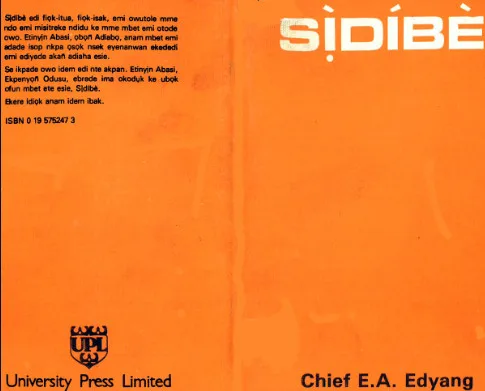
This article is part of a series celebrating three Efik literary classics that have kept culture alive through storytelling. In this piece, we explore the work of Ernest Etifit Edyang, whose play Sidibe captures the tension between tradition, identity, and transformation.
Can a story change how a society sees itself?
When voices from the margins begin to rise…
When long-standing norms are challenged…
When destiny unfolds in unexpected ways…
Stories become more than stories—they become mirrors.
Efik literature has long served as a bridge between past and present, carrying the language, values, and lived realities of a people through time. What began as oral tradition found new life in written form, shaped by writers who understood the urgency of preserving identity in a changing world.
This article is part of a series celebrating three Efik literary classics that have kept culture alive through storytelling. In this piece, we explore the work of Ernest Etifit Edyang, whose play Sidibe captures the tension between tradition, identity, and transformation.
Chief Ernest Etifit Edyang was a distinguished Efik playwright whose work significantly shaped the development of modern Efik drama. He hailed from Ibeno, in present-day Akwa Ibom State, and was later closely associated with Duke Town in Calabar, where he became deeply integrated into the cultural and intellectual life of the Efik people. His professional journey reflected a strong commitment to education and literary development—he taught at both Duke Town School and the prestigious Hope Waddell Training Institution, and also served as a librarian at the Calabar Public Library, placing him at the heart of literary access and knowledge dissemination in his time.
Edyang’s literary contributions span several dramatic works, including Sidibe, Asibọñ Edem, The Bride Price, and The Emotan of Benin. Among these, Sidibe and Asibọñ Edem remain the most prominent within the Efik literary tradition. His plays are deeply rooted in societal realities, often drawing from historical events, cultural practices, and traditional belief systems. In particular, Asibọñ Edem explores social and political life in Old Calabar while bringing to life indigenous beliefs such as Akanga—a spiritual vow believed to shape an individual’s destiny even before birth.
His most celebrated work, Sidibe, stands as a powerful example of Efik dramatic storytelling. Presented as a serio-comic drama, the play reflects and critiques societal structures, especially the rigid customs and marriage decrees that reinforce inequality and social division. Through its narrative, Sidibe highlights the tension between the ruling class and the common people, exposing the emotional and social consequences of oppressive traditions. At its core, the play presents the triumph of fate, dignity, and moral truth over unjust societal systems.
The impact of Sidibe extended beyond the written page. It was performed by the Calabar Cultural Association in Ibadan in 1958, demonstrating its cultural relevance and performative strength. In 1963, the play gained international acclaim when it won first prize for the Rosamond Gilder Award at a pan-African literary contest organized by an American university. This recognition not only elevated Edyang’s status as a playwright but also brought Efik drama into global literary consciousness.
Through his work, Ernest Etifit Edyang did more than tell stories—he challenged societal norms, preserved cultural identity, and expanded the possibilities of indigenous African drama. His legacy endures in the continued study and performance of his plays, as well as in the broader recognition of Efik literature as a vital part of Africa’s literary heritage.
Sidibe — A Story of Destiny, Grace, and Transformation
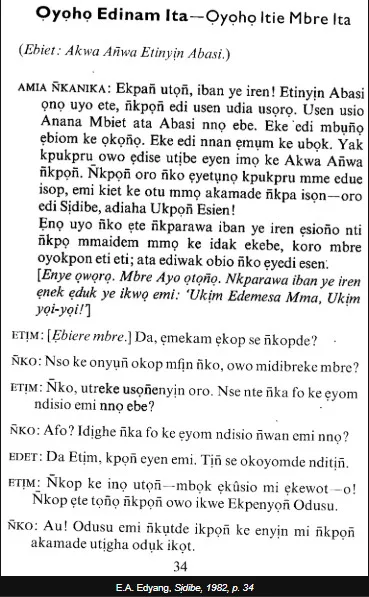
Sidibe is set in the ancient community of Adiabo, where the life of a young woman named Sidibe unfolds against the backdrop of royalty, tradition, and fate. Born into a poor but kind-hearted family, Sidibe grows up far removed from privilege, yet carries within her a rare beauty, strength of character, and quiet dignity.
Her life takes an unexpected turn when she is brought into the royal palace, where she encounters figures such as Prince Ekpenyong Abasi and Princess Ananambiet. As relationships develop, tensions begin to rise—driven by envy, status, and long-standing traditions. Sidibe’s presence challenges the order of the palace, eventually influencing change, including the repeal of an unjust decree.
Through trials, recognition, and eventual elevation, Sidibe rises from obscurity to become a central figure within the royal household. Her journey reflects the triumph of virtue over adversity, showing how destiny, faith, and character can reshape even the most rigid social structures.
Edyang’s storytelling goes beyond entertainment.
In Sidibe, he explores social hierarchy and inequality, the power of character over status, the role of destiny in human life, and the possibility of transformation.
The story resonates because it feels real—rooted in human emotion and societal truth.
Readers interested in Sidibe can explore its availability across both international and local platforms. The play is published in Nigeria by University Press PLC, where it is listed among recommended literary texts for schools, with ISBN 9789781542336 and an approximate retail price of ₦1000. Copies may also be sourced through Amazon, while library holdings and catalog records are accessible via WorldCat. In Nigeria, the play is also accessible through academic bookstores, African literature distributors, and cultural bookshops that specialize in indigenous literary works.
Sidibe reminds us that beginnings do not define endings.
That dignity matters. That character matters. That change is possible.
It is a story that speaks to anyone who has ever felt overlooked—and dared to hope for more.